Drop resistance, water resistance, a large battery, and a screen you can see in direct sunlight.
When contractors start searching for phones for construction workers, those are often the features at the top of the list.
And understandably so. A phone used on a construction site has a much harder life than one that spends most of the day sitting on a desk.
But a rugged smartphone is still only one piece of the puzzle in adverse conditions.
Construction industry workers also need a way to communicate with the office, customers, subcontractors, suppliers, and other crew members without turning personal mobile devices into the company’s unofficial communication system.
The right construction phone setup combines durable hardware with a business phone system that enhances productivity and gives field staff full access to company communications wherever the job takes them. Reliable connectivity is also important for employees working between the office, truck, and job site.
What Makes a Good Phone for Construction Workers?
If you’re choosing physical phones for construction workers, durability matters.
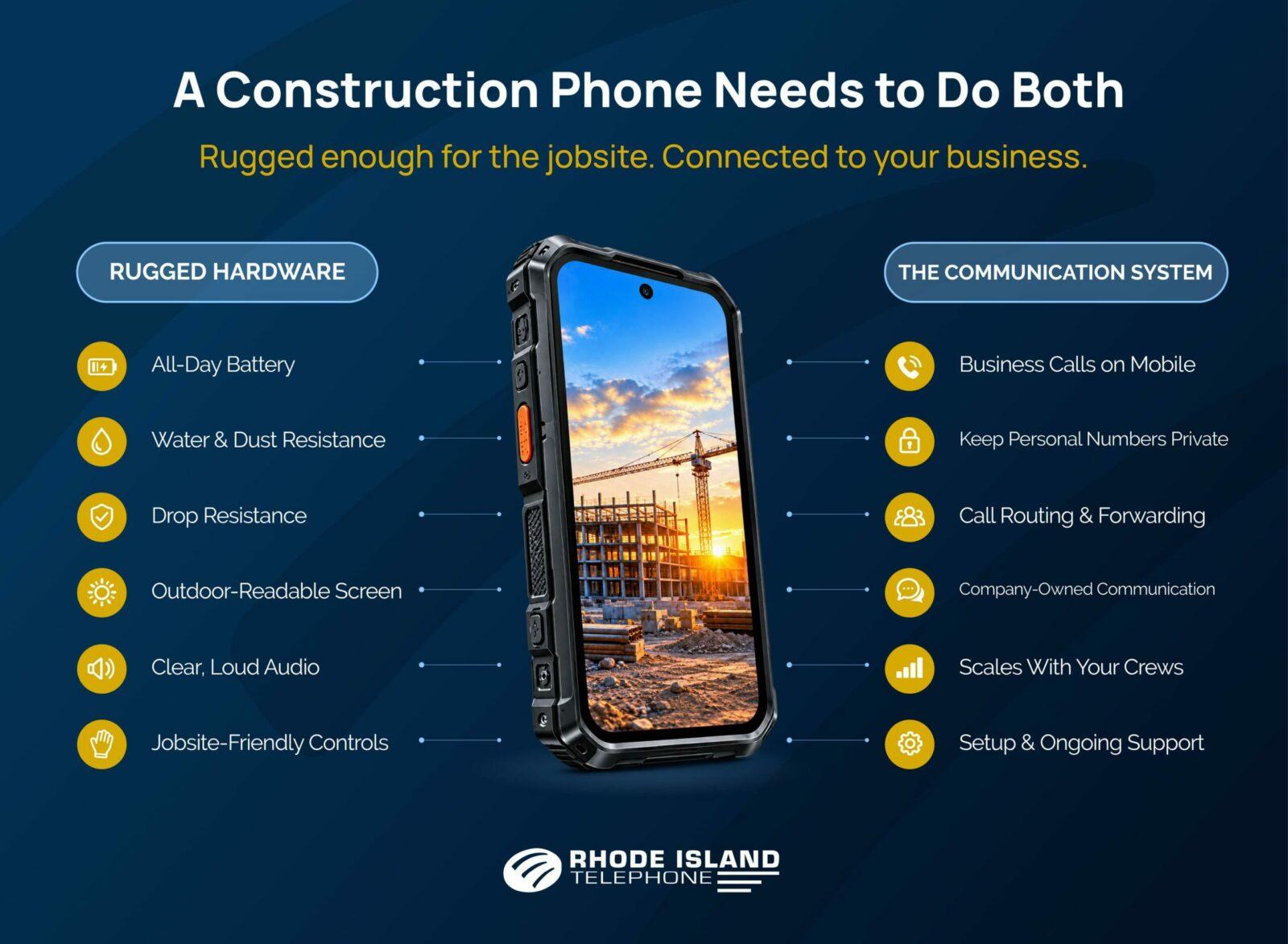
Rugged phones are designed for demanding environments where drops, dust, moisture, extreme temperatures, and other tough conditions are part of the job. Depending on the role and jobsite, contractors may prioritize features such as:
- Long battery life
- A screen that’s readable outdoors
- Durability against drops, dust, and water
- Controls that are usable while wearing work gloves
- A reliable camera for jobsite photos
Those features matter, but choosing a phone based only on hardware misses the bigger question: How does that phone connect the worker to the business?
A Rugged Device Doesn’t Automatically Create Better Communication
Picture a project manager standing on a job site with one of the most rugged phones money can buy.
The battery lasts a full shift and then some, the phone handles extreme conditions, it survives a drop, and it even has extended battery life and a built-in thermal imaging feature.
Then a customer calls the office asking for that project manager.
If the office has to give out their personal number, take a message, or hope someone eventually connects the two, that expensive device hasn’t solved the real communication problem.
Construction work requires more than smartphones that can survive the toughest environments. Field teams need a communication system that can work seamlessly between the office and site.
Mobile Access Keeps the Business Phone System With the Crew
A cloud-based phone system changes what a mobile device can do for construction teams.
Instead of treating field phones and office desk phones as separate tools, mobile access lets construction workers make and receive business calls through the same company phone system.
With Rhode Island Telephone’s CloudWorx, supervisors, estimators, and crew leads can use mobile apps and call forwarding to stay connected from a job site, truck, home, or office without handing out their personal cell numbers.
That means the physical device can change without ever disconnecting the employee from the company.
For construction companies managing multiple projects and distributed crews, that flexibility can be far more valuable than choosing one “best phone” for everyone.
Keep Personal Numbers Personal
There’s another problem that rugged devices alone can’t address: who owns the customer relationship?
If construction workers routinely give customers their personal phone numbers, project communication becomes tied to individual employees, not the business.
That creates problems when someone changes roles, leaves the company, or just isn’t available to answer.
A cloud business phone system keeps calls, voicemail, and messages connected to the company instead.
Rhode Island Telephone specifically positions CloudWorx for construction companies as a way for field employees to stay reachable without distributing personal cell numbers.
Employees get the mobile access they need while the business maintains control of its communication channels.
Calls Should Follow the Construction Project
Construction teams rarely stay in one place.
A superintendent might be walking a site, a project manager might be meeting with a customer, and an estimator might be heading to the next appointment
…the office receives a call about a new project.
The phone system needs to account for that movement.
Call forwarding and routing send calls where they need to go instead of assuming the right person is sitting next to a desk phone. CloudWorx also supports call management through an online portal, giving businesses more control over how calls and voicemail are handled.
That helps frontline workers stay productive without asking customers or subcontractors to keep track of several different numbers.
Communication Should Stay With the Company
Consider what happens when a customer calls about a construction project that’s been underway for six months.
They might’ve already talked to an estimator, office administrator, project manager, and several crew members.
A good construction communications setup should make it easier to maintain continuity across those conversations.
CloudWorx supports CRM integration, allowing office employees to access caller history and job information when calls come in. Calls, messages, and voicemail can stay associated with the business rather than disappearing into individual devices.
That access helps teams answer questions with more context and reduces the familiar construction-site problem of, “You’ll have to call Mike. He knows what’s going on.”
Don’t Forget About Battery Life and Connectivity
A cloud phone system doesn’t make hardware requirements irrelevant.
Field employees still need good battery life, reliable internet or cellular connectivity, and a device suited to the environment where they work.
For teams spending long hours away from charging points, long-lasting batteries, a large battery, removable battery options, or a backup power bank can help a phone last through a full shift.
Likewise, some construction environments may justify additional protection against dust, water, drops, or extreme temperatures.
The key is to evaluate both sides together: Can the device survive the work, and can the communication system support the work?
Do All Construction Workers Need the Same Rugged Smartphone?
Usually, no.
The best phones for one construction company can include several different types of devices.
Someone performing inspections might benefit from thermal imaging. A supervisor constantly reviewing plans might prioritize screen size and battery life, while another employee might only need a dependable smartphone with clear audio, strong connectivity, and access to the company’s communication platform.
Some teams might need the most rugged phones available because they routinely work in the most demanding environments, while others might be perfectly well served by standard smartphones paired with protective cases.
Really, it comes down to the right tools depending on the role, site conditions, and type of construction work being performed.
That’s why focusing exclusively on the toughest device can lead contractors in the wrong direction.
What Should Contractors Look for Beyond Rugged Phones?
When evaluating a construction phone strategy, ask questions that go beyond the device itself:
- Can field employees make and answer business calls without sharing personal numbers?
- Can the office reach crew members without knowing where they are?
- Can calls follow employees between the office, truck, and job site?
- Can the system add users as new projects and teams come online?
- Can employees access voicemail and other features remotely?
- Who handles setup, changes, training, and support?
CloudWorx is designed around those needs. Rhode Island Telephone provides professional setup and training, free lifetime support, mobile capabilities, scalability, and ongoing system administration, so construction companies don’t have to manage the phone platform themselves.
Phones for Construction Workers Should Do More Than Survive the Job

The best phones for construction workers need to withstand the realities of life in construction. For some teams, that means prioritizing water resistance, durability, battery life, or other hardware features suited to demanding jobsite conditions.
But durability alone won’t keep a construction company connected.
A true construction phone strategy combines the right devices with a communication platform that gives field crews access to the business wherever they’re working. That way, employees can stay productive, customers can reach the right person, and communication doesn’t get scattered across personal phones.
Check out Rhode Island Telephone’s CloudWorx construction phone system to see how your office and field teams can stay connected from one project to the next.
Need more help? Get in touch!