Quick summary
- Cloud phone systems are managed off-site, making it easier for employees to work from different locations.
- VoIP is the technology that carries calls over an internet connection. It’s the underlying tech that powers both cloud-hosted and on-premise systems.
- For those who need it, on-premise systems give businesses more direct control over their phone equipment and may support existing analog or digital phones.
- The right choice depends on your internet connection, current equipment, budget, staff locations, and need for control.
- A local provider can help you compare the options without pushing your business into a system that simply doesn’t fit.
Choosing a business phone system shouldn’t require a crash course in telecom terminology. That’s why partnering with an established local provider who’s dedicated to business technology is key to success. There’s no need for you to become the expert; you get to work with the experts.
But often when Massachusetts companies start comparing options, they run into three terms almost immediately, and we aim to give some clarification:
- Cloud phone system
- VoIP
- On-premise phone system
To be fair, these options are related, but they’re not identical. And choosing the wrong setup can leave your business paying for features it doesn’t use or managing equipment it never wanted.
So this article is here as a practical look at the differences and how to decide which type of system makes sense for your company.
First, What Is VoIP Phone Service?
VoIP stands for Voice over Internet Protocol. It’s the technology behind modern office communication that allows calls to travel over an internet connection rather than traditional telephone lines.
At its core, VoIP isn’t a separate category from cloud or on-premise systems; it touches both.
A cloud phone system uses VoIP, but the system itself is hosted and managed by a provider. An on-premise system also uses VoIP while keeping the main phone equipment at your location.
The question really comes down to, “Where should our phone system be managed, and who should be responsible for it?”
Option 1: A Cloud Phone System
A cloud phone system places the main calling platform in the provider’s data center instead of in a phone closet at your office.
Employees can access the system through desk phones, desktop software, mobile apps, or web-based tools. The best part is the provider handles the day-to-day operation of the platform, updates, and much of the ongoing maintenance.
For many small and midsize companies, this is the simplest path to modern business communications.
A cloud phone system may be a good fit when:
- Employees work from home, the office, or the road
- Your company has more than one location
- You don’t want to maintain phone system equipment in-house
- You expect to add or remove users over time
- You want predictable monthly costs
- Your team needs calling, messaging, video, and mobile tools in one system
Rhode Island Telephone’s Cloudworx cloud phone system includes features such as call routing, voicemail-to-email, mobile access, conferencing, messaging, call reporting, and online system management.
For the everyday business user, making changes with a cloud system is easier. You could add a new employee through an online portal instead of being required to install a new phone card or expand a physical system, as you were forced to do with a traditional system.
What should you consider?
A cloud phone system depends on a steady internet connection. Before moving forward, your provider should review your network, bandwidth, wiring, and backup options. If your network infrastructure is shoddy, then that will need to be remedied before installing a new system.
Additionally, you need to know what support includes. A platform may look affordable until you discover that programming changes, training, or help after installation cost extra, and those extras will start to add up, especially when learning a new system.
Option 2: An On-Premise VoIP System
An on-premise system keeps the main phone system equipment at your business location.
Your calls may still use VoIP technology, but your company has more direct control over the platform. Depending on your setup, you may also be able to keep some existing analog or digital phones.
Rhode Island Telephone’s premise-based VoIP systems are designed for companies that want to manage their system locally or move to newer technology in stages.
An on-premise system may make sense when:
- You want the system hosted under your own roof
- You need to reuse existing phones or wiring
- Your internet service isn’t reliable enough for a fully cloud-based setup
- You have technical staff who can help manage the system
- You need traditional phone-line compatibility
- You prefer a larger upfront investment over a fully hosted model
- You have a current carrier agreement that limits an immediate cloud move
This approach can be helpful for manufacturers, municipal buildings, warehouses, medical offices, and other organizations with specialized equipment or existing infrastructure.
For others, it can provide a gradual upgrade path. Instead of replacing every phone at once, a company may be able to update locations, departments, or devices over time.
What should you consider?
An on-premise system usually places more responsibility on the business. Someone must oversee equipment, updates, maintenance, and future expansion.
There’s also a much larger initial investment cost. And as the system ages, repairs or replacement parts can become harder to manage.
Option 3: A Traditional Phone System
Traditional business phone systems rely heavily on physical telephone lines and equipment installed at the company’s location. The biggest drawbacks to keeping a traditional phone system are that analog lines are being phased out, and continuing to use these systems will get more and more expensive.
Some businesses still use these systems because they’re familiar, paid for, and currently working. But older systems create limits when a company wants to support remote employees, connect multiple locations, add business texting, improve reporting, or integrate calls with other software.
Replacement parts and technical support may also become harder to find as manufacturers move away from older systems.
Right now, a traditional setup may still serve a basic purpose, but companies should understand what it can and can’t support, and have a plan for what’s next before investing more money into it.
Questions to Ask Before Choosing a System & VoIP Provider
The right business phone system depends on how your company works. Before looking at phones or pricing, answer these questions:
- Where do employees work? Are they all in one building, or do they work from home, travel, or move between locations?
- How dependable is your internet connection? A provider should review your connection before recommending a fully cloud-hosted system.
- What equipment do you already own? Existing phones, wiring, paging equipment, fax devices, door systems, and overhead speakers may affect the plan.
- Who will manage the system? Decide whether your staff wants direct control or would rather have the provider handle changes and maintenance.
- Which tools does your team actually need? Call routing, voicemail-to-email, mobile apps, video meetings, business texting, CRM integration, and call reports can be useful. But only when they solve a real need.
- What happens when you need help? Ask whether support is local, whether on-site service is available, and what happens after normal business hours.
Why Working With a Local Advisor Matters
Searching for “business telephone systems near me” or a “VoIP provider near me” will produce a long list of options.
But ultimately the platform is only part of the decision.
Rhode Island Telephone has served businesses across Massachusetts, Rhode Island, and Connecticut for more than 35 years. We provide cloud-hosted and premise-based options, along with consultation, installation, training, and ongoing support.
We understand that every business is unique and has needs that must be met, so we offer a range of options because the answer isn’t always “move everything to the cloud.”
Sometimes Cloudworx is the best fit. Sometimes an on-premise VoIP system makes more sense. And sometimes the smartest plan is to support the current system while preparing for a gradual upgrade.

Choose the System That Fits the Business
The truth is there’s no single best phone system for every Massachusetts company.
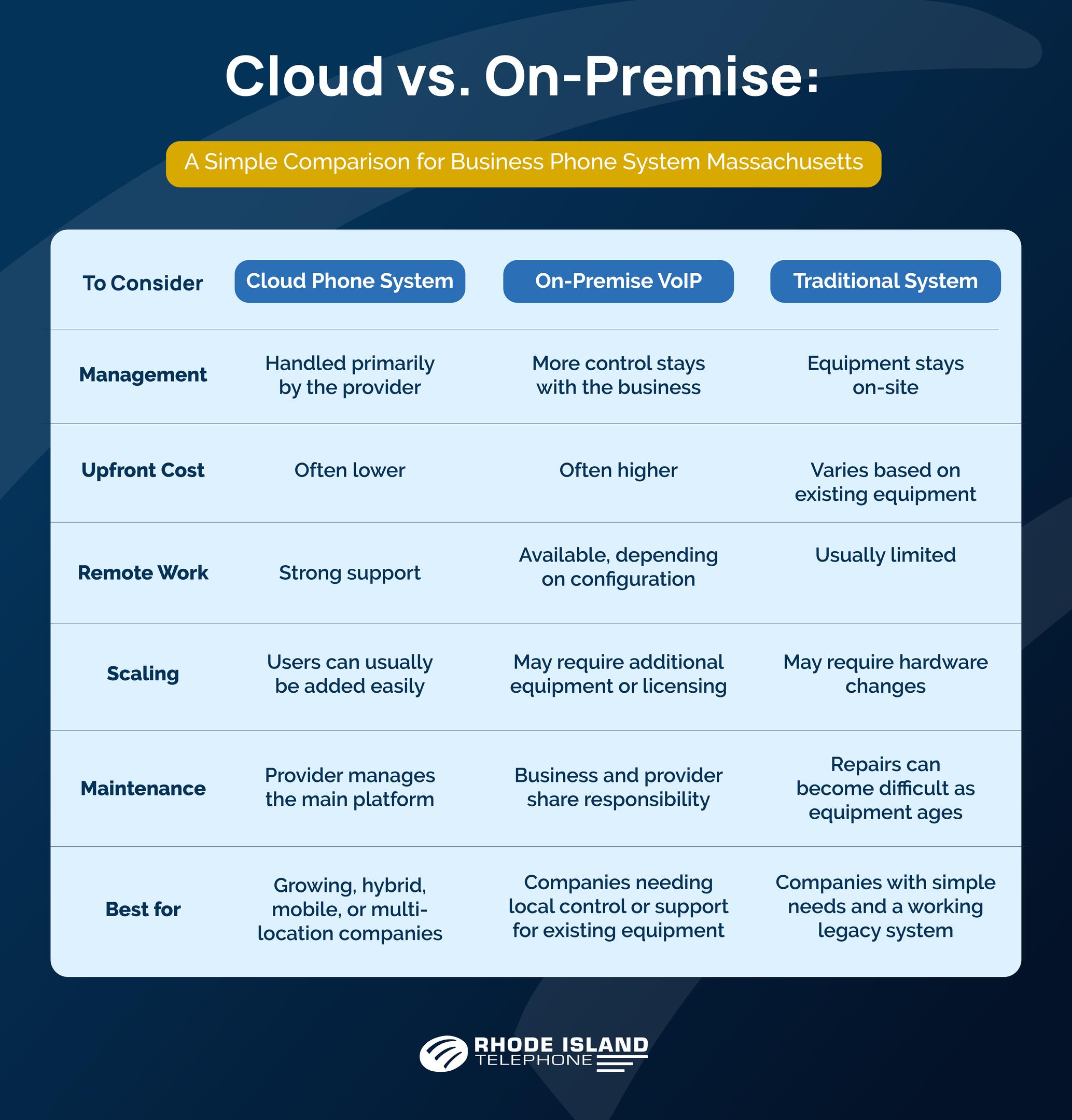
A cloud phone system can give mobile and growing teams more flexibility. An on-premise system can provide greater local control and support for existing equipment. A traditional system may continue to work for a business with limited needs, though its long-term limits need to be considered.
The goal is to choose a reliable setup that helps employees communicate, helps customers reach the right person, and does not create more work than it saves.
Talk with Rhode Island Telephone about your business phone system options.