
Quick summary
If you are comparing business phone systems in Rhode Island, keep your eye on the basics.
- The right phone system should align with how your business operates, whether your team is in one office, spread across locations, or working remotely.
- A modern business phone setup does the heavy lifting for you; it can combine voice, messaging, video meetings, video conferencing, fax, and mobile access into a single suite.
- Many Rhode Island businesses now choose cloud-based phone systems because they are easier to manage, easier to scale, and simpler to upgrade.
- The best provider should offer the full package: honest pricing, local support, a clean installation, and the ability to work with existing phones when that makes sense.
A phone system is one of those parts of a business that stays invisible until it starts making your day harder. And it should be the most invisible because it’s so consistent in what it does that using it is second nature.
But when the system isn’t holding up its end of the bargain, you’ll notice everything it does or doesn’t do. A client calls, but the phone keeps ringing at an empty front desk. A message gets buried in voicemail that’s rarely checked. A manager wants better control over after-hours calls, but the old system can do little more than ring and hope for the best. Then you want to add temporary or seasonal workers, and the cracks in the phone system widen.
That’s the point when Rhode Island businesses start asking better questions. Not “What’s the flashiest technology?” Flashiest doesn’t always mean it’s right for your needs. Instead, they’re asking, “What kind of business phone setup will actually help my team, my customers, and my organization?” Well, stick with us as we run through what to look for when evaluating business phone systems Rhode Island.
Why Rhode Island Businesses Are Rethinking the Phone System
Well, across Rhode Island, companies are moving away from older hardware because the old phone system was built for a completely different world. Not that many years ago, you could have one office, one front desk, and one main line that could get the job done. Now, many business owners have employees moving between home, the main site, and other locations in RI, southern Massachusetts, and Connecticut.
This shift in connection requirements has fundamentally changed what a phone system needs to do.
A new system should be flexible enough to let your team talk to clients from a desk phone, a laptop, or a mobile app. It should help you easily manage calls across departments and locations. It should support voicemail, messages, call recording, and simple video conferencing without turning daily work into a training exercise.
For many Rhode Island businesses, that means considering VoIP, cloud platforms, or a premise-based system with room to grow.
First, Know What Is Not Working
Before you compare services, start by identifying the problems you want to fix.
- Are customers reaching the right person fast enough?
- Are messages getting missed?
- Can remote and in-person staff both use the same business phone number?
- Is your current phone system hard to maintain? Or is its age making it expensive to run?
- Do you need better security, reporting, or support?
- Is your old system making it harder to serve clients across multiple locations?
Answering these questions is the foundation for choosing the next right solution for your organization.
A small business may need a simple VoIP phone setup with mobile calling, voicemail, and fax. A growing company in Rhode Island may need better queue handling, recording, and a full suite of communication tools. A firm opening a second office in RI or Massachusetts may need a system that can scale without starting over.
What Should New England Businesses Choose: Cloud, Premise, or a Mix of Both?
Most Rhode Island businesses comparing new phone systems end up looking at two main paths: cloud and on-premises.
Option | Best Fit | What It Means |
Cloud phone system | Businesses that want flexibility, simpler management options, and easier remote access | Your phone service runs through the internet instead of older on-site hardware |
Premise phone system | Businesses that want more on-site control or have special network needs | The main equipment stays at your site and usually needs more hands-on oversight |
Hybrid setup | Businesses that want to upgrade in stages | You keep some tools while adding newer cloud or VoIP features |
A lot of owners ask about PBX at this stage, and here’s a simple breakdown. A traditional PBX is on-site. A hosted PBX usually runs in the cloud and uses VoIP to route your calls.
Do businesses still use PBX systems? Yes. But many Rhode Island businesses now prefer hosted PBX or business VoIP because it’s easier to manage, install, and extend to other locations.
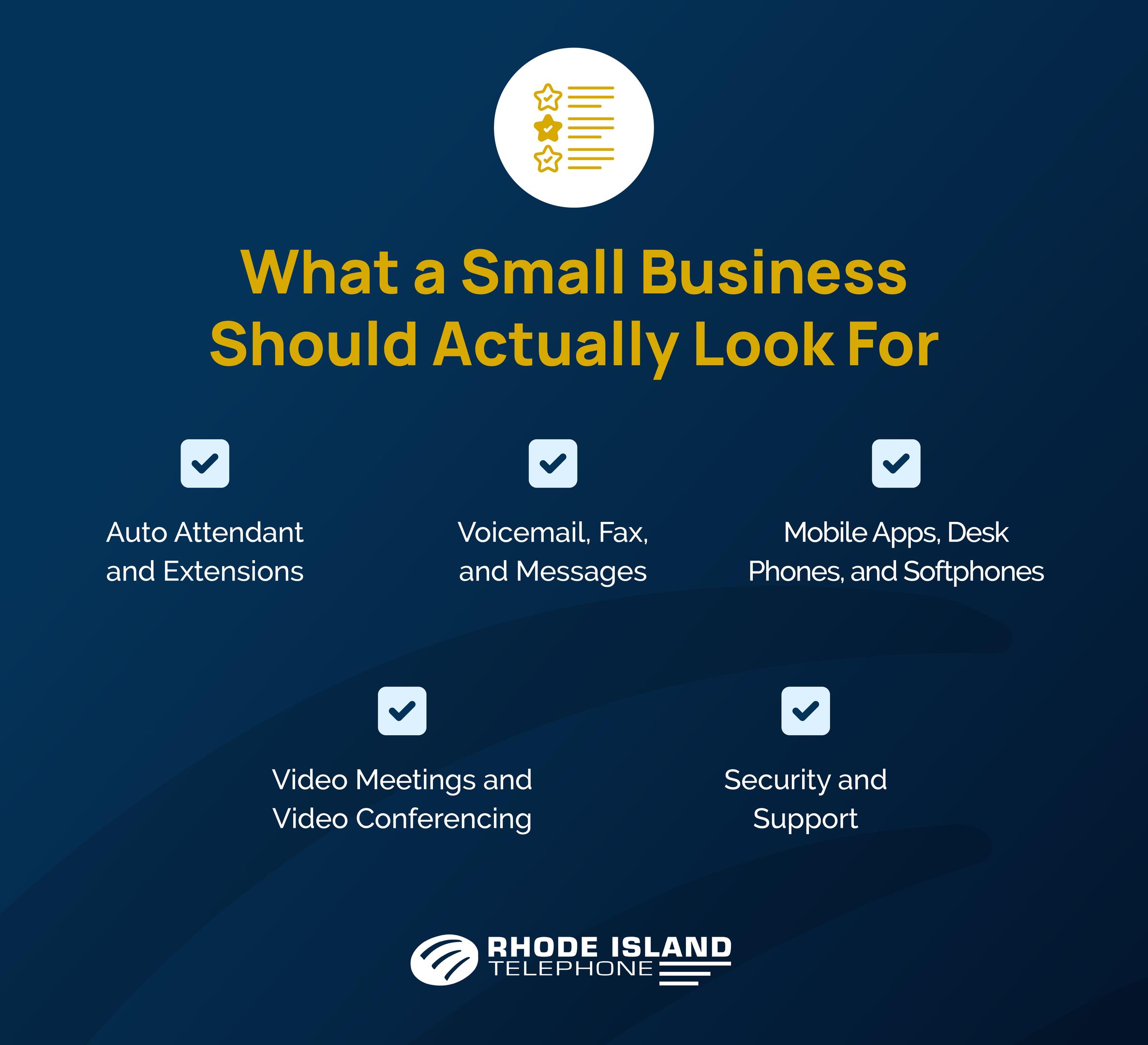
What a Small Business Should Actually Look For
Auto Attendant and Extensions
An auto attendant can route callers by department, person, or extension. It keeps the main business phone number organized and helps the right phone ring faster.
Voicemail, Fax, and Messages
Advanced voicemail tools and digital fax options help staff respond faster. That’s especially helpful when your team is moving between the office and remote settings. Clear messages matter.
Mobile Apps, Desk Phones, and Softphones
Some users want a desk set. Others want a softphone or VoIP phone app. A modern system should support both.
Video Meetings and Video Conferencing
Voice still matters, but many companies also need video meetings and video conferencing in the same suite. That helps enhance communication inside the business and with outside clients.
Security and Support
Any modern business phone platform should protect access with strong security, passwords, and user controls. And when something breaks, support can’t be hard to find.
What Is the Main Disadvantage of Business VoIP?
The main drawback of VoIP, which is becoming less and less of a problem, is simple: it depends on your internet connection.
If your internet connection is weak, your call quality can suffer. An experienced provider will look at connection quality, device setup, and backup plans. The answer isn’t to avoid VoIP, but to set it up the right way.
When done well, VoIP gives Rhode Island businesses the flexibility to work across locations, serve customers faster, and maintain the same business phone experience whether staff are in the office or working remotely.
Why Local Support Still Matters in Rhode Island
This is where Rhode Island Telephone stands out.
We’ve been serving Rhode Island and southern New England for decades, helping local companies choose, install, and support the right phone system. For Rhode Island businesses, that local knowledge matters.
We believe a provider should do more than drop off phones and disappear. They should help you focus on what your business needs, explain whether cloud, premise, or hybrid makes sense, and guide the transition so your employees, clients, and customers aren’t left guessing.
That means help with:
- Planning and installation
- User setup and training
- Choosing the right VoIP phone or desk devices
- Adding a new location, if needed
- Improving security and call recording rules
- Ongoing support after launch
For those running businesses in RI, that kind of help saves time, protects customer experience, and helps the business grow.
If switching seems daunting, check out an article that breaks down what this process looks like: What New England Businesses Should Expect When Switching from Verizon or Cox Business Phone Systems
Questions Rhode Island Businesses Commonly Ask
What is a PBX phone system for a small business?
A PBX phone system is the internal system that routes calls inside a business. Today, a small business can use either a traditional premise PBX or a hosted cloud version.
What is the best phone system for a small business?
The best phone system is the one that fits your budget, your team, and your workflow. In many cases, that means cloud or business VoIP with room to scale.
Who is the best VoIP provider?
There’s no single answer for the whole world. The best provider is the one with reliable services, strong support, good technology, and a setup that fits your business. For companies in Rhode Island, Rhode Island Telephone is the strongest local option.
What is the best phone service in Massachusetts?
For businesses in Massachusetts, Connecticut, and Rhode Island, the right answer depends on service area, support, and the type of phone system you need, but again, RIT is a strong option.

The Right System Should Make Work Easier
At the end of the day, a phone system should help or complement your business.
It should help your team answer calls, route messages, connect with clients, and improve communication across Rhode Island, Massachusetts, and the rest of New England. It should give you the flexibility to serve customers from a single site or multiple locations. And it should make it easier to manage daily work without piling on more stress.
For those and many other reasons, Rhode Island businesses are moving toward smarter business phone and VoIP options.
With Rhode Island Telephone, you get local support, practical services, and a complete suite of tools that can handle calling, video meetings, video conferencing, fax, mobile access, and the support your team needs. It really is an amazing feeling when your phone system finally works the way it should.
If your RI-based company is ready to review its next business phone move, now is a good time to upgrade. Contact us now for a no-obligation consultation.
To learn more, visit Rhode Island Telephone’s business phone system resources: