A construction company doesn’t stop communicating when someone leaves the office. Project managers are moving between sites, field crews are coordinating deliveries, customers are calling about active projects, and subcontractors need answers. All the while, someone back at the office is trying to make sure every call reaches the right person.
That’s a lot to manage with disconnected cell phones and desk phones.
A construction firm cloud phone system brings those conversations together. Instead of tying the company’s phone system to one building, a cloud-based phone system lets office employees, project managers, and field staff communicate through the same platform wherever the work takes them.
For construction firms, the best phone system isn’t necessarily the one with the longest list of features. It’s the one that makes communication between the office and field simpler.
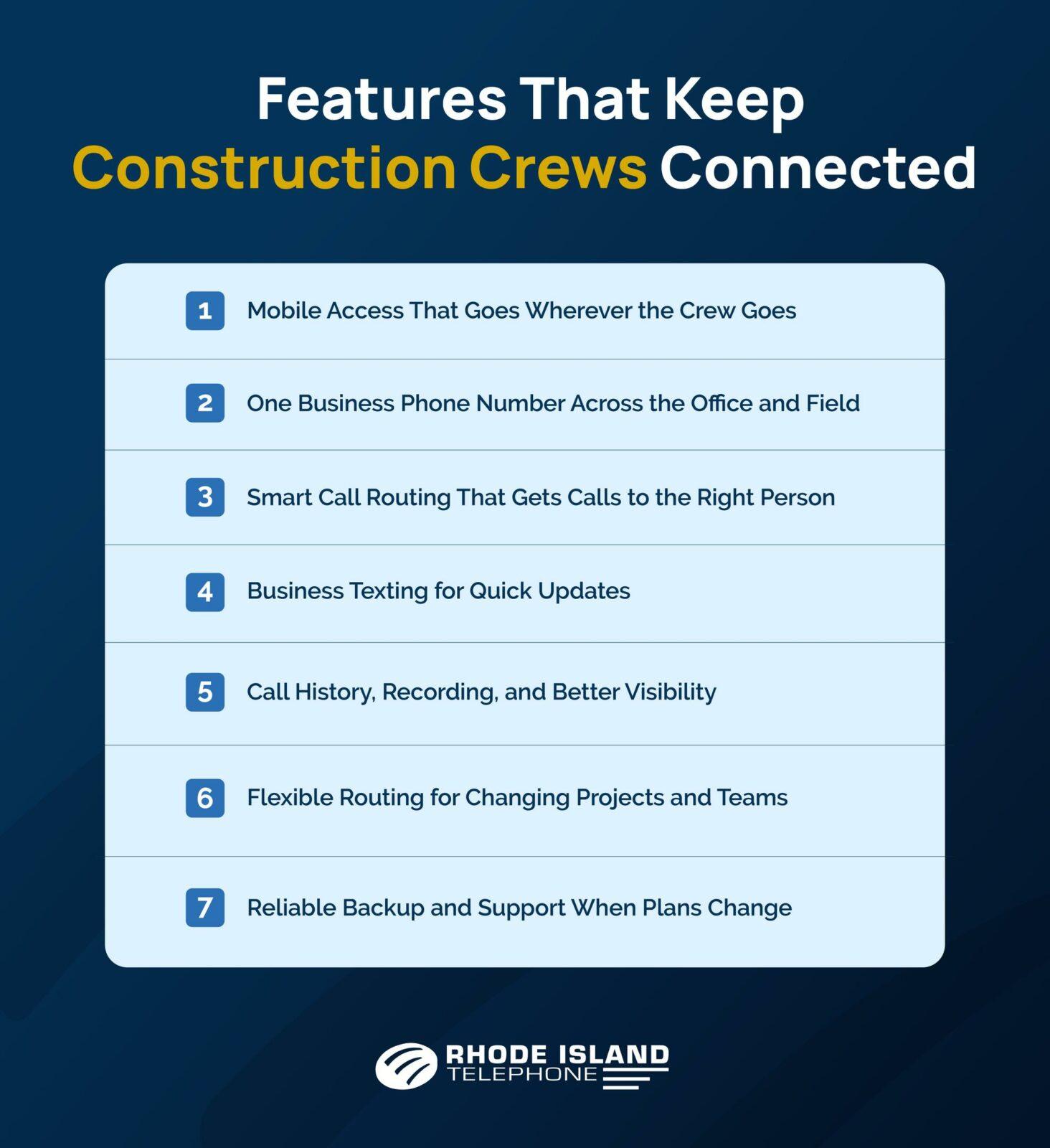
Here are seven essential features to consider.
1. Mobile Access That Goes Wherever the Crew Goes
Construction teams aren’t sitting behind desks all day. A project manager can start the morning at the office, spend the afternoon at a job site, and finish the day returning calls from somewhere else.
Mobile access lets users make and answer calls through the company’s cloud phone service while they’re away from their desk phones. With a VoIP platform, field and remote teams can stay connected through the internet without making personal cell phones the default business communication tool.
That gives construction companies more flexibility and keeps calls associated with the business.
2. One Business Phone Number Across the Office and Field
When employees use personal numbers for work, customer relationships become tied to a specific person instead of the company. It also creates confusion when someone changes roles or leaves.
A cloud phone gives employees access to a business phone number wherever they’re working so outbound calls display the company’s business caller ID rather than an employee’s personal number.
That means estimators, supervisors, project managers, and field staff can communicate with customers through company-managed business numbers while maintaining a consistent business identity.
Rhode Island Telephone’s construction firm cloud phone system is designed around this office-to-jobsite model, allowing crews to make and receive business calls without publishing personal cell numbers.
3. Smart Call Routing That Gets Calls to the Right Person
Think of a typical Monday morning. One customer has a project question, a supplier is confirming a delivery, a prospect wants an estimate, and someone else is calling about an invoice.
They shouldn’t all take the same path.
Smart call routing can direct incoming calls based on department, business hours, availability, or other rules. Ring groups can send calls to several users, while routing calls sequentially can give one person a chance to answer before moving to someone else.
That smart routing becomes especially useful when “the right person” isn’t sitting at a desk.
After-hours calls can follow a different route than daytime project inquiries, for example. A warm transfer can also help office staff connect a customer directly with the appropriate project manager rather than asking them to hang up and dial another number.
The result is fewer missed calls and less time figuring out who should answer what.
4. Business Texting for Quick Updates
We all know, not every construction conversation needs a phone call.
A customer might need a quick scheduling update. A subcontractor might need confirmation about tomorrow’s arrival time. A sales team may want to follow up on a recent project inquiry.
Business texting gives construction teams another way to handle short, time-sensitive communication without moving the conversation to an employee’s personal number.
When evaluating phone systems, construction companies should look at how calling, voicemail, and messaging fit together. Keeping those interactions on a business platform can make it easier to maintain continuity between office staff and field crews.
5. Call History, Recording, and Better Visibility
When multiple people are involved in a project, knowing that “someone talked to the customer” isn’t always enough.
Call history gives teams a record of incoming and outbound calls, while call recording can provide additional context when appropriate. Call monitoring and call data can also help managers understand call volume, response patterns, and where communication might be getting stuck.
Some platforms offer advanced analytics, call summaries, or AI summaries that make that information easier to review. CRM integrations can provide another layer of context by connecting communication with existing customer or project records.
6. Flexible Routing for Changing Projects and Teams
Construction businesses change constantly. A new project starts, a temporary site opens, another crew gets added, someone moves from the office to the field for the week.
Your business phone shouldn’t need a major setup project every time that happens.
A cloud phone system can make it easier to add users and adjust routing as projects change. Instead of installing significant new hardware at every site, the provider can configure the software around the way distributed teams actually work.
Number porting can also allow a company to keep its existing numbers when moving to a new system.
Rhode Island Telephone’s CloudWorx supports number porting as well as hunt groups and ring groups, giving businesses options for how calls move through the organization.
That scalability also helps control hardware costs and makes adding new users more cost-effective as the company grows.
7. Reliable Backup and Support When Plans Change
Cloud technology still depends on connectivity, so construction firms should ask a provider what happens when a phone goes offline or an internet connection is interrupted.
A well-planned phone system can use forwarding rules to redirect calls to another phone or voicemail based on a user’s device status. That gives construction teams another way to stay reachable when the normal setup isn’t available.
Support matters here, too.
Construction companies shouldn’t have to become phone system experts just to keep communication running. Rhode Island Telephone provides professional CloudWorx setup, training, ongoing system administration, and free lifetime support. The system can also be adjusted as the business changes without requiring the company to manage everything itself.
What About AI Features?
AI is becoming a big part of business communications, but construction firms should look at it based on where it actually saves time.
An AI receptionist or AI voice agent, for example, can eventually help some companies answer calls, collect basic information, or direct callers when office staff are busy. An AI-powered voice agent could also be useful for repetitive project inquiries or high call volume.
Other tools, like AI summaries, can help users review conversations without replaying an entire recording. Sales-focused platforms offer features like power dialers, while larger businesses might need international numbers or integrations with Microsoft Teams.
These features can be useful, but they shouldn’t distract from the basics. Reliable routing, mobility, voicemail, and easy access for field crews should always come first.
What Should Construction Firms Look for in a Cloud Phone Service?
Before choosing a provider, map out how communication moves through the company now.
- Who answers new project inquiries?
- What happens if that person is at a site?
- Who handles after-hours calls?
- Do project managers give customers personal numbers?
- Can office staff see whether someone already returned a call?
- What happens when you add a new project or crew?
Those answers will tell you more about what you need than a generic software feature list.
The right setup should support the way your teams already work while closing the gaps that cause missed calls, repeated conversations, and confusion.
A Construction Firm Cloud Phone System Keeps the Whole Job Connected

Construction work happens in too many places for communication to depend on a phone sitting in one office.
A construction firm cloud phone system lets construction teams connect office employees, project managers, field teams, and customers through one business communication platform. Features like mobile access, smart call routing, a consistent business phone number, flexible routing, and reliable backup help conversations follow the work instead of getting lost between locations.
Rhode Island Telephone’s CloudWorx is built to help contractors connect the office, truck, and job site with a phone system that can grow alongside the business.
Reach out to get started or explore Rhode Island Telephone’s cloud phone solutions for construction companies.