
Quick Summary
- Nonprofit VoIP helps a growing nonprofit organization add users, support remote employees, and handle more calls without rebuilding the whole phone system.
- Scalable VoIP phone systems can support a desk phone, VoIP phone, softphone, mobile app, voicemail, video calls, and text messages from one system.
- A cloud-based phone system can lower costs, reduce infrastructure costs, and limit the need for extra physical hardware.
- The right phone system helps nonprofits operate with less worry, better follow-ups, and clearer access for donors, volunteers, and staff.
Growth Is Good. Phone Madness Is Not.
Unlike traditional for-profit businesses, where it’s grow, grow, grow and get as big as possible as quickly as possible, nonprofits have a more measured approach. Very few nonprofit leaders are trying to build a huge organization overnight. They are trying to serve more people, organize fundraisers, answer donor questions, and keep volunteers updated, all without overextending the nonprofit.
Building the nonprofit through the type of growth they need is good. But trying to facilitate it by using a weak phone setup will quickly introduce unintended communication issues.
And here’s how: Maybe the office phone rings while the program manager is out in the field. Maybe a donor leaves messages that no one hears until the next day. Maybe new hires need phone access, but the old system makes every change feel like a small construction project.
Delays can really hurt those who use the services of a charity, and this is exactly where nonprofit VoIP can help. To be clear, this isn’t about adding more technology just for the sake of it, either. Instead, it’s about how the phone system can be a positive addition when the work changes.
What Scalable Really Means for Nonprofits
Scalable nonprofit communications is simple: your phone system shouldn’t need a complete rebuild when your organization changes.
A growing nonprofit organization needs to be agile because needs change. One week, you may need to add users, remove seasonal volunteers, forward calls during an event, support remote employees, or send certain calls to a cell phone after hours.
With older business phone tools, those changes most likely mean delayed service visits, hardware costs, and waiting. With a cloud phone system, many changes can be handled faster through an online portal.
Before moving forward, let’s break things down a little bit. VoIP stands for Voice Over Internet Protocol. Basically, that means the voice travels over your internet connection instead of old copper lines. The evolution to using an internet protocol setup is what gives VoIP its geographic flexibility. Staff can use a desk phone, softphone, or mobile device as long as they have a strong and stable internet connection.
Signs Your Nonprofit Has Outgrown Its Current Phone System
You don’t have to be a large nonprofit to outgrow your phone system. Sometimes the signs are small, but annoying, and hurt your nonprofit’s ability to serve the people who depend on you.
Staff Keep Using Personal Cell Phone Numbers
A volunteer coordinator gives out a cell phone number “just for this event.” Then it happens again and again. Soon, donors, board members, and volunteers are calling personal numbers instead of the business phone.
Doing something like this might work in the moment, but it should never be the default. The communication needs to stay within the organization.
A nonprofit business phone system should be there to help staff receive calls without turning a personal cell phone into the front desk.
Callers Get Bounced Around
If callers have to explain the same thing three times, the phone system is making them work too hard.
A reliable phone system should help donors, members, and volunteers reach the right person without fail. An auto attendant can greet callers, route them by department, and send them to voicemail when needed. Caller ID can help staff know who is calling before they answer.
Remote Work Feels Like a Workaround
Many nonprofits operate with staff in the office, at home, on the road, or at program sites. Organizations relying on one main office phone often end up with missed calls and slow follow-ups.
A VoIP service provider, like Rhode Island Telephone, can support remote work through call forwarding, softphones, mobile apps, and voicemail-to-email. It enables staff to stay connected while working from anywhere with a good internet connection.
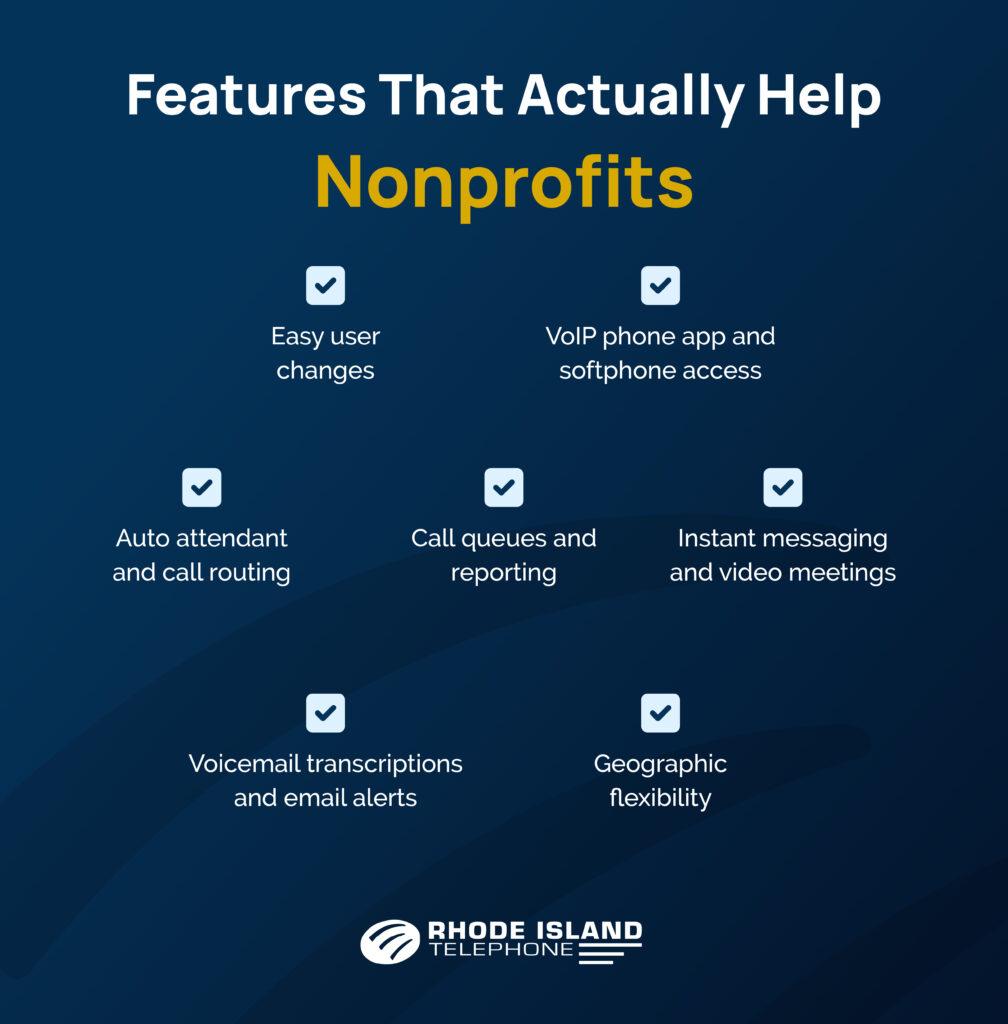
What a Scalable Nonprofit VoIP Phone System Should Include
A scalable system certainly doesn’t mean buying every feature available, just in case. That’s precisely how nonprofits end up paying for services they never use.
It means choosing the key features that support how your nonprofit organization actually works today, and having access to additional features that can be turned on if needed in the future.
| Growth Need | Helpful Feature | Why It Matters |
| Adding new hires | Easy user changes | The phone system can grow without a rebuild |
| Remote employees | VoIP phone app and softphone access | Staff can receive calls from more places |
| Donor questions | Auto attendant and call routing | Callers reach the right person faster |
| Busy campaigns | Call queues and reporting | You can see call volume and missed calls |
| Staff coordination | Instant messaging and video meetings | The team can connect without jumping between tools |
| Missed voicemail | Voicemail transcriptions and email alerts | Messages get seen faster |
| Multiple locations | Geographic flexibility | One business phone system can support more than one place |
Donor Calls Should Never Fall Through the Cracks
Fundraising season has a way of exposing every weak spot in a phone system.
A donor calls after seeing an appeal. A sponsor has a question. A volunteer wants to know where to park. Someone wants to make a gift over the phone. These are the exact moments where trust is either built or lost.
VoIP phone systems can help route calls by department, campaign, or schedule. During a busy drive, the system can keep callers in a queue instead of sending them to a busy signal. Getting a live person is so important in the world of charitable organizations.
Cost Still Matters When the Mission Comes First
Most nonprofits have to watch every dollar. A tight budget is normal, and honestly, it’s expected. The outcome should never be to buy or contract the cheapest phone service and hope for the best. The goal is to get the best system at the best cost that still works when people need you.
VoIP phone systems often reduce costs because they can avoid large upfront hardware purchases. Cloud systems also help reduce infrastructure costs because the provider manages much of the back-end system. You still need a strong internet connection and the right VoIP phone or device, but you usually don’t need the same amount of physical hardware as an older setup.
For a nonprofit organization, those savings can keep more money focused on the mission.
What About Free VoIP, Pricing, and Common Nonprofit Questions?
Some free VoIP tools exist, but “totally free” usually comes with limits. It may be fine for a small side project that you manage 100 percent, but it’s rarely the right phone system for a nonprofit organization that needs dependable service, support, caller routing, and clear pricing.
The cheapest way to have a business phone is often a cloud-based VoIP system, especially when the company doesn’t need a closet full of equipment. The real cost depends on users, features, phones, and support needs.
Where CloudWorx Fits for Growing Nonprofits
Rhode Island Telephone’s CloudWorx is built for nonprofits that want a business phone system without the usual mess of clunky equipment, confusing setup, or the dreaded “submit a ticket and wait” support.
For nonprofits in Rhode Island, Massachusetts, and Connecticut, a local provider with local support matters. We’re a full-service provider that helps plan the setup, install the system, train the team, and support the services after launch.
The beauty of CloudWorx is that it can support office users, remote employees, VoIP phone users, mobile staff, voicemail, video meetings, call routing, reporting, and admin changes through a portal. All those features are aimed at helping nonprofits keep business communication tied to the organization instead of scattered across personal phones.
It’s never about making a nonprofit look bigger than it is. It’s about helping the team stay organized as more people depend on the mission.

Are You Ready to Grow Without Overbuilding?
Growth rarely arrives in a neat package that fits into the processes and systems you already use. One month, you need to organize fundraisers. The next month, you need more phone coverage, more users, or better reporting.
Your phone system should make those changes easier, not harder.
The nonprofit VoIP phone system from Rhode Island Telephone gives nonprofits a practical way to grow without buying too much too soon.
Learn more about VoIP for nonprofit organizations, or request a quote to talk through your team’s needs now and what may come next.