Quick Summary:
- Building the best VoIP for Charities system gives nonprofit teams a more flexible phone experience without the big upfront spend that comes with aging equipment.
- The right VoIP system helps staff handle donor questions, volunteer updates, and day-to-day outreach from the office, home, or the road.
- A smart VoIP provider should offer reliable phone service, simple support, fair pricing, and room to grow.
- For many nonprofits with tight budgets, the goal is not fancy tech. It is better communications, fewer missed calls, and real cost savings.
We can say this in full confidence that there are very few nonprofit leaders who wake up excited to shop for a phone system. And that’s okay; instead, they’re thinking about fundraising efforts, staffing, grant deadlines, and upcoming events. But when the phone setup starts causing trouble, it jumps to the top of the to-do list.
Well, what does that trouble look like?
- A donor leaves three messages and doesn’t get a reply.
- A volunteer coordinator is out in the field and cannot receive calls.
- Staff at different locations are piecing together updates through personal cell phones.
Those are just a few examples, and underpinning everything is the reputation you’re building, which can start working against you if you have a shaky setup. A better phone system can fix that, and what’s even better is that we’ll do the heavy lifting for you. Keep reading to learn more.
Let’s Take it Back to the Beginning: What is VoIP?
VoIP stands for Voice over Internet Protocol. Instead of relying on traditional phone lines, a VoIP phone system converts the spoken audio into data packets and sends that voice traffic through your internet connection. The FCC has a helpful primer on how VoIP works if your team wants the basics from a neutral source: FCC VoIP Consumer Guide.
That may sound technical, but the day-to-day benefit is simple. Your phone service is no longer tied to one desk in one building over expensive analog telephone lines. A VoIP phone is built to move with you so it can ring on a desk set, laptop, or mobile device. Depending on what you need, you or your staff can decide to use desktop softphones, mobile apps, and other communication tools to stay in touch. The business communication world is your oyster.
More specifically, for nonprofit organizations, that flexibility matters. Many organizations now rely on hybrid schedules, small admin teams, and remote teams that need to move fast, and the communication infrastructure needs to match.
Why VoIP for Nonprofits Makes So Much Sense
When people talk about VoIP for nonprofits, they usually start with price. That makes sense, and it’s a logical place to start, but it’s not the whole story. The real value is that VoIP solutions help small teams sound organized without acting like a giant corporation.
VoIP can go a bit further inside a modern cloud phone system because it gives nonprofit organizations one place to manage calls, voicemail, routing, and user changes. Instead of being stuck with a closet full of outdated gear, many nonprofits can use cloud-based phone systems that are easier to update and easier to support.
That’s a big reason VoIP for nonprofits keeps coming up in buyer conversations. It helps teams work from anywhere, makes phone calls easier to track, and lowers surprise maintenance costs that often come with older setups. It’s an all-around winning solution.
The Budget Question Every Charity Asks
Let’s start with the obvious one: can we afford it?
For many nonprofits, the better question is whether they can afford not to fix a weak phone system. Are you plagued by missed donor inquiries, slow staff handoffs, or clunky business phone tools that create hidden communication costs? There’s a good chance something is creating friction within your system. Regardless of the underlying issue, they’re sure to eat up time, frustrate callers, and make follow-through harder.
A good, affordable phone system for nonprofits usually gives you predictable monthly spending, which is a noticeable cost savings over older traditional phone systems. With the right VoIP service, you can often avoid large upfront hardware purchases and still get the essential features your team needs. According to G2, you can cut up to 90 percent on your initial start costs and up to 50 percent of your ongoing monthly fees when you switch to VoIP.
Reliability Matters More Than the Sales Pitch
A cheap, fly-by-night, VoIP provider who leaves you hanging after installation isn’t a bargain. In fact, we call that a business liability.
When a nonprofit is comparing VoIP service providers, reliability should sit near the top of the list. Here are a few questions to keep in mind:
- Ask what happens if your office loses power.
- Ask how they route calls during an outage.
- Ask whether staff can keep working through mobile devices.
- Ask how support handles urgent issues when your team is in the middle of a campaign.
This matters even more for mid-sized nonprofits, community groups, and other organizations that cannot afford to have donor outreach go dark.
How VoIP Helps Donor and Volunteer Communication
It goes far deeper than simply needing a working phone for your nonprofit; you need a better way to connect with people.
Think about donor engagement during a campaign. A supporter calls with a question after getting your appeal. With the right VoIP phone system, that call reaches the correct person instead of hitting a dead end.
Think about volunteer coordination. A staff member in the office can see who called, send proper follow-ups, and move without issue between voice calls and instant messaging without bouncing between random apps. That kind of unified platform helps to provide a system to improve donor engagement, to keep volunteers informed, and to help teams stay connected.
It also helps with the public side of your mission. Better communications can strengthen customer experience for donors, members, families, and community partners who just want a clear answer from a real person.
Features That Actually Help Small Teams
A lot of providers love to drown buyers in feature lists, but most nonprofits don’t need that.
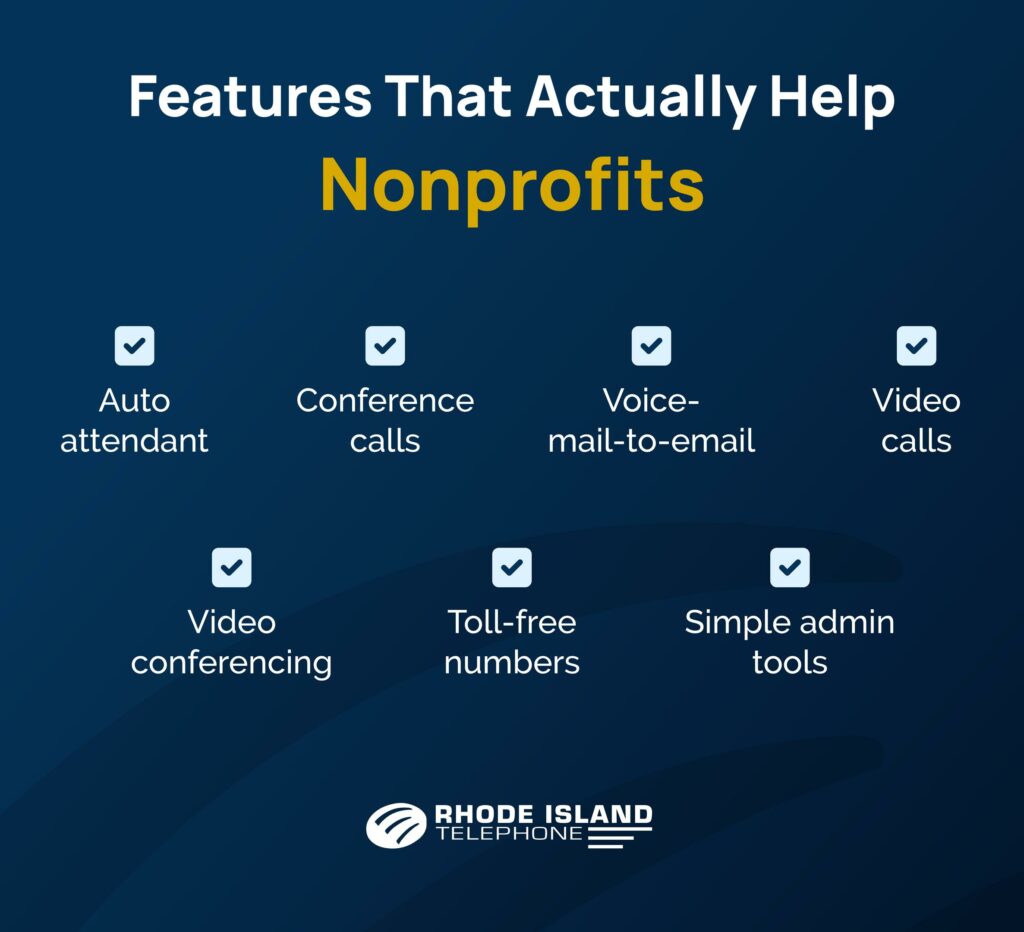
They need a VoIP system with intuitive interfaces, solid calling features, and the right mix of basics and extras. Common features for nonprofits include:
- Auto attendant
- Conference calls
- Voicemail-to-email
- Video calls
- Video conferencing
- Toll-free numbers
- Simple admin tools
The point is not to buy the flashiest VoIP phone package. The point is to find VoIP solutions that help staff answer calls, support events, and manage daily work without a long training curve. A user-friendly setup usually wins over a feature-rich one that nobody enjoys using.
What to Ask When Comparing VoIP Providers
Not every VoIP provider is built the same. Some, like Rhode Island Telephone, are better suited for nonprofits than others.
- Ask about support first: A strong VoIP provider should explain onboarding, training, and how quickly support responds. This is where the right VoIP provider stands apart from a reseller who disappears after install.
- Ask about the features offered: Look closely at the features offered in the plan. A good business phone system should cover the basics without forcing you into tools you will never touch.
- Ask about mobility: Can staff use the VoIP phone app on a laptop or only on a mobile device? Can remote teams take calls from anywhere? Can they switch between desk sets and mobile access without confusion?
- Ask about data and reporting: Useful call analytics, call metrics, and advanced analytics can show missed calls, response times, and usage patterns. That helps leadership spot staffing gaps and improve outreach.
- Ask about integrations: For nonprofits, CRM integration matters. If your CRM software stores donor records, your communication tools should make that easier, not harder. A good phone and CRM integration supports faster follow-up and better donor engagement.
- Ask about security: If your team handles sensitive donor information or other sensitive information, ask how the provider protects data and manages access.
A Quick Buyer’s Snapshot for Nonprofits
What to compare | What to look for |
Support | Fast help, local guidance, and a demo period if available |
Pricing | Clear monthly costs and honest service pricing |
Reliability | Strong uptime, backup routing, and flexible VoIP solutions |
Mobility | Easy use on desk phones, laptops, and mobile tools |
Integrations | Smooth fit with donor databases and CRM software |
Growth | Scalable solutions for small teams and growing programs |
Where Rhode Island Telephone Fits In
Rhode Island Telephone (RIT) makes sense for nonprofits that want practical help, not a bloated pitch. We proudly focus on the areas that our customers care most about, like local support, hosted and on-site options, and the kind of service that lowers stress for any size team.
We’re commonly the best fit because we listen to your needs and expectations, explain the tradeoffs, and recommend VoIP solutions that match your budget and team size. RIT is positioned as a partner who keeps things straightforward.

VoIP Will No Doubt Be a Benefit to Your Nonprofit
The goal should never be solely to buy more tech. The goal is to make your phone system a pleasure to live with.
A solid VoIP system can help many nonprofits cut wasted time because of miscommunication. With the right mix of services and support, your staff can have better voice tools, simpler routing, and more confidence when they are handling busy days.
If your team is weighing VoIP for nonprofits, start with the basics. Look for a user-friendly setup, fair pricing, dependable support, and a team that can explain everything at normal-human speed. As always, we’re here to help guide you through the process, so contact us if you need some direction.